

Semantic layer
Fallen-8’s semantic layer takes unstructured documents (PDF, Word, Excel, PowerPoint, HTML, markdown, plain text) and turns them into ordinary graph state: one Document vertex, its content as Chunk vertices carrying the text and an embedding, a deduplicated network of Entity vertices the text mentions, and typed edges between them. From there everything you already know applies, because nothing about these vertices is special: fused search finds a chunk by describing it, and the hit is a vertex id you can feed straight into path finding or subgraphs.
The scenario this serves: you keep describing knowledge in documents. Ingest them, then type “the server that terminates TLS for the shop”, land on the matching chunk, and walk the graph from there, through the entities it mentions.
Want to see it rather than read it? The
Wind Farm Fleet Integrity sample loads an asset graph and ingests
three synthetic documents (a PDF with a figure, a spreadsheet, a markdown standard) through this exact
pipeline in one click, then walks you to the payoff: a chunk whose mentions edges reach both
the entity network and the real equipment, and a fleet-wide risk that no document states.
Quick start
Section titled “Quick start”In the compose environment ingestion is on by default: the
docling sidecar (document conversion) and the nlp sidecar (entity/term extraction) start
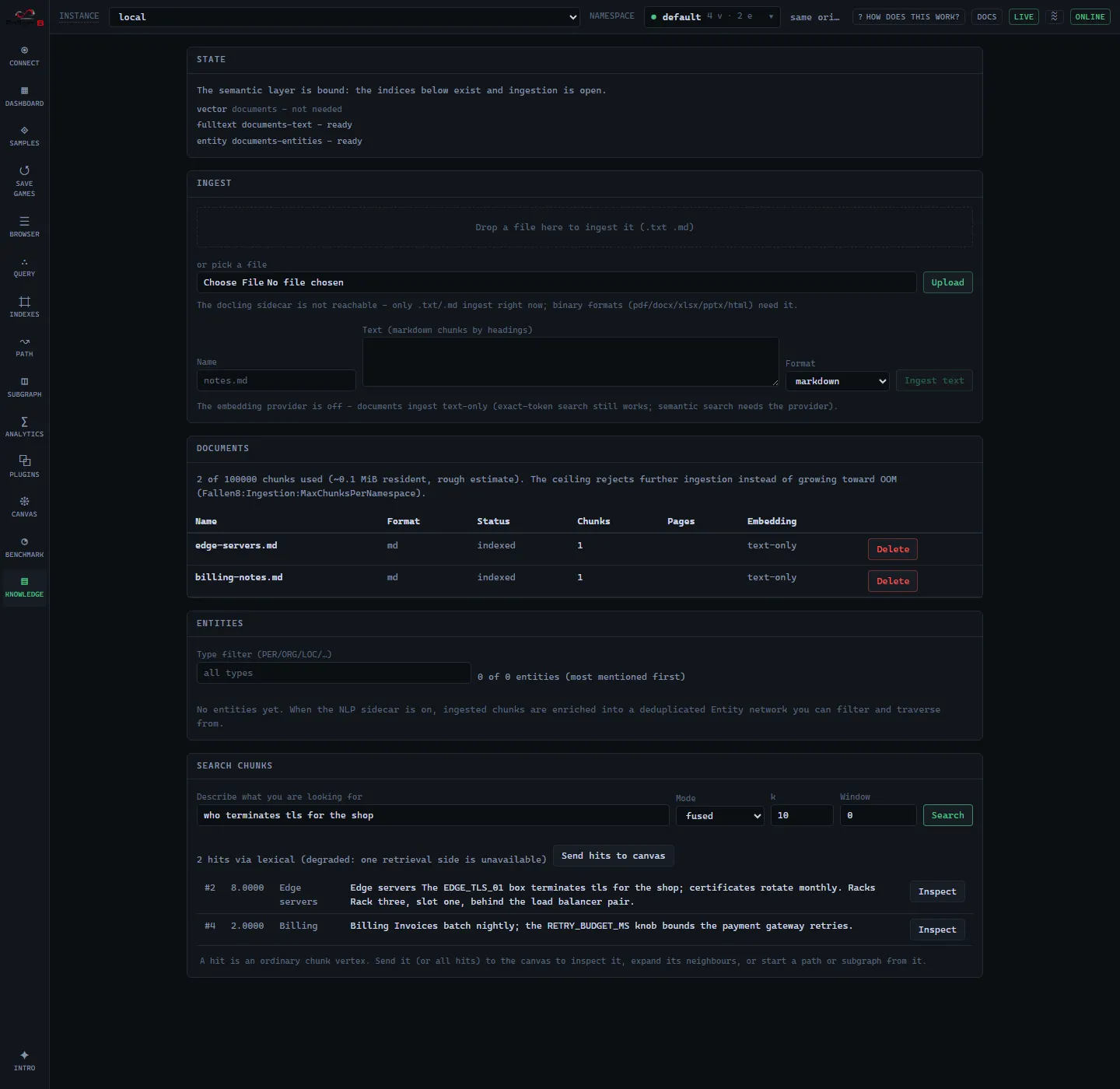
with everything else, and F8 Studio’s Knowledge screen (last in the rail, after Benchmark)
offers upload, drag-and-drop, raw-text ingest, the entity view and search. Opt out of the
whole thing with F8_INGESTION=false, or of just the entity enrichment with F8_NLP=false.
Before the first ingest you bind the semantic layer once, creating the indices it uses. Nothing is created implicitly (see Binding); in the Studio the State panel does it with one click.
Over REST:
# 1. Bind the layer once (creates the required indices; idempotent):curl -sf -X POST http://localhost:8080/document/binding/ensure
# 2. Markdown/plain text ingests WITHOUT the docling sidecar:curl -sf -X POST http://localhost:8080/document/text \     -H "Content-Type: application/json" \     -d '{ "name": "edge-notes.md", "text": "# Edge\n\nEDGE_TLS_01 terminates tls." }'
# Binary formats convert in the docling sidecar first; the options are form fields:curl -sf -X POST http://localhost:8080/document \     -F "file=@handbook.pdf" \     -F "sourceUri=https://wiki.example/handbook" \     -F 'propertiesJson={"team":"platform"}'
# Manage:curl -sf http://localhost:8080/document            # list + chunk budgetcurl -sf http://localhost:8080/document/3          # one document + chunk previewscurl -sf http://localhost:8080/document/entities   # the entity network, most-mentioned firstcurl -sf -X DELETE "http://localhost:8080/document/3?waitForCompletion=true"
A bare dotnet run has ingestion off (Fallen8:Ingestion:Enabled, default false); every
/document route answers 403 until it is enabled. Outside compose the two sidecar endpoints are
empty by default and have to be named too: Fallen8:Ingestion:Docling:Endpoint (without it every
binary format answers 503) and Fallen8:Nlp:Enabled plus Fallen8:Nlp:Endpoint (without both,
no entity network). GET /status carries the whole capability state (ingestion: enabled flag,
accepted formats, sidecar reachability, enforced limits; nlp: enabled/configured/reachable),
which is exactly what the Studio gates its UI on. Both ingest routes and /document/search sit
behind the sensitive-endpoint rate limiter, so a burst answers 429
(see security).
Ingest options
Section titled “Ingest options”Both routes take the same options. On POST /document they are form fields alongside the
file part, and the two structured ones are JSON strings:
| Option | POST /document/text (JSON) |
POST /document (form field) |
|---|---|---|
| Document name | name (required) |
name (defaults to the file name) |
| Content | text, plus format: markdown (default) or plain |
the file part; the format follows its extension |
| Embed the chunks | embed (default true) |
embed |
| Source pointer stored on the Document vertex | sourceUri |
sourceUri |
| User tags | properties (object of string values) |
propertiesJson (that object as a JSON string) |
| Replace another document on success | replaceDocumentId |
replaceDocumentId |
| Structural linking | link |
linkJson (that object as a JSON string) |
User tags are copied onto the Document vertex and onto every chunk, so they are the handle
for “everything that came from this source”. A tag key that would shadow a key of the document
graph model (name, status, text, order, identifiers, keyTerms, enriched, …) is
refused with 400 rather than silently renamed.
The pipeline, end to end
Section titled “The pipeline, end to end”Ingestion is asynchronous: the request creates the Document stub and returns 202 Accepted immediately; the heavy work (convert, chunk, embed, enrich, write) runs off the
request thread on a single global FIFO queue shared by every namespace, drained in arrival
order by one worker. A large scanned PDF never blocks the caller or holds a connection open;
its Document row simply shows processing and flips to indexed when the worker finishes,
live over the change feed.
%%{init: {'theme':'base','themeVariables':{'fontFamily':'ui-monospace, SFMono-Regular, Menlo, Consolas, monospace','lineColor':'#666666'}}}%%
flowchart TB
    upload["POST /document or /document/text"]:::client
    accept["202 Accepted<br/>Document vertex · status processing"]:::sys
    queue["Global FIFO queue<br/>one worker · arrival order · carries the namespace"]:::sys
    convert["docling convert<br/>(binary formats only, async task API)"]:::ext
    chunk["chunk + identifier extraction"]:::sys
    embed["embed chunks<br/>(embedding provider)"]:::ext
    writeChunks["write Chunk vertices<br/>+ contains / next / embeddings / fulltext"]:::sys
    nlp["NLP enrich<br/>(spaCy: entities + key terms)"]:::ext
    writeEntities["write Entity vertices + mentions edges<br/>(additive)"]:::sys
    done["Document · status indexed"]:::sys
    feed["change feed<br/>(live status)"]:::sys

    upload --> accept --> queue
    queue --> convert --> chunk --> embed --> writeChunks --> nlp --> writeEntities --> done
    accept -.->|processing| feed
    done -.->|indexed| feed

    classDef client fill:#45494D,stroke:#666666,color:#FEFEFE
    classDef sys fill:#141516,stroke:#45494D,color:#FEFEFE
    classDef ext fill:#141516,stroke:#666666,color:#C6C7C8,stroke-dasharray:5 4
Step by step, and the order matters:
- The Document vertex is created first with
status: processing, then the job is enqueued and202returned. Status transitions are ordinary committed property writes, so progress rides the change feed with no special machinery. A worker that dies mid-flight leaves aprocessingrow; the next startup removes its chunks and sweeps it tofailedwithinterruptedas the reason. - Parse. Binary formats convert in the docling-serve
sidecar (MIT) over its async task API, which returns structured output: heading hierarchy,
intact tables and page numbers survive. OCR is off by default (born-digital PDFs need
none, and it is the dominant cost on scanned documents); turn it on with
Docling:DoOcr=true. Figures are not chunked, and neither are the captions docling attaches to them (page headers and footers are dropped by design too), so meaning that lives only in a caption is not retrievable: repeat it in the body prose. Markdown and plain text skip this step entirely, so text ingestion needs no sidecar. A binary upload is refused up front with 503 only when no endpoint is configured; with an endpoint set but the sidecar unreachable the upload is still accepted (202) and the Document row endsfailed, carrying the docling reason in itserror. - Chunk. Sections split along headings, merge below
ChunkMinChars(default 800), split aboveChunkMaxChars(default 4,000) at paragraph boundaries. Tables stay intact as their ownkind: tablechunks; oversize tables split into row windows that repeat the header. Identifier-shaped tokens (RETRY_BUDGET_MS,CheckoutService,0x1A2B) are extracted per chunk into itsidentifiersproperty. The shapes are exact: an underscore token that starts with an uppercase letter and is at least 4 characters, CamelCase with at least two humps and 6 characters, or0x…hex. Lowercase (edge_tls_01), hyphenated (edge-tls-01) and short tokens never extract, andMaxIdentifiersPerChunkbounds how many a chunk keeps (first occurrence wins). - Embed. Chunk texts embed through the embedding provider
in batches. With the provider off, pass
"embed": falseto ingest text-only; ingestion never silently skips embedding. - Write the chunks. Chunk vertices (
Chunk),containsedges from the document,nextedges in reading order, the embeddings, and a mirror of each chunk’s text into the fulltext index. This happens before enrichment on purpose: the chunks are durable first, which is what lets the next step be additive. A failure up to here leaves exactly one failed Document vertex and zero chunks;DELETE /document/{id}removes any document with its whole subtree. - Enrich (optional), then write entities. When the
nlpsidecar is on, the already-written chunks are sent to it and the result folds into the graph as an entity network: Entity vertices andmentionsedges in their own pass. Enrichment is additive - if NLP is off, unreachable, or errors, the document still reachesindexedwith its chunks intact andenriched: false. It never fails an ingest.enrichedis a property of the Document vertex (GET /graphelement/{documentId}), not a field of the/documentresponses.
Binding the semantic layer
Section titled “Binding the semantic layer”The layer creates no index implicitly. Ingestion resolves the indices it needs and answers
428 Precondition Required until they exist, so an index is never conjured as a side effect of
an upload. You bind once, explicitly:
curl -sf http://localhost:8080/document/binding # the state: which indices, ready?curl -sf -X POST http://localhost:8080/document/binding/ensure # create the missing onesThree roles make up the binding, each an ordinary index you can also create yourself (with the configured id and shape) on the Indexes screen:
- vector (
documents) - a bound vector index over the chunk embeddings; the kNN side of fused search. Required when embeddings are on. - fulltext (
documents-text) - the lexical side of fused search. - entity (
documents-entities) - a dictionary index that deduplicates Entity vertices; required when NLP is on.
GET /document/binding reports each role’s exists/ready state and an overall ready; the
Studio’s State panel renders exactly that and offers a single “Create the required indexes”
button. ensure is idempotent, and it refuses (409) to reuse an id already held by a
wrong-shape index rather than clobbering it.
The entity network
Section titled “The entity network”With the nlp sidecar on, ingestion enriches chunks into a deduplicated Entity graph. The
sidecar is a small, offline FastAPI + spaCy service (MIT), English-only,
that returns named entities (doc.ents) and key terms (noun chunks) per chunk. It runs in one of
two tiers, chosen automatically by the same NVIDIA-GPU detection that accelerates NL assist:
- No GPU (default): the CPU-friendly
en_core_web_lgmodel. - NVIDIA GPU: the
en_core_web_trftransformer (roberta) model on the device, for best-in-class English accuracy.npm run env:upapplies this automatically;F8_GPU=0/1forces the tier either way.
The output is identical in both tiers; only accuracy differs. Override the model with the
F8_NLP_MODEL build ARG (kept in lockstep with the runtime env of the same name).
- Entity vertices (label
Entity) are deduplicated per namespace on(type, normalized text), so the same organisation mentioned across ten chunks and three documents is one vertex. It carriestext(the first surface form seen),type(the spaCy label, e.g.PERSON/ORG/GPE) andnormalized.typeis a general English model’s guess, and identifier-shaped tokens are frequently mistyped (WTG_A17comes back asGPE), so treat?type=as a convenience filter, not a schema. mentionsedges run chunk -> entity, capped per chunk (Nlp:MaxEntitiesPerChunk).- Key terms land on the chunk as a newline-joined
keyTermsproperty.
# The entity network, most-mentioned first; filter by type or substring:curl -sf "http://localhost:8080/document/entities?type=ORG&limit=50"Each entity id is a valid graph seed. In the Studio the Entities view lists them (with a
type filter and mention counts) and “Canvas” drops one on the canvas, where expanding its
mentions reaches every chunk it appears in - a describe-find-traverse loop that runs through
the concepts the corpus talks about, not just its text.
Fused search
Section titled “Fused search”POST /document/search retrieves chunks with two signals fused: dense kNN over the
embeddings and lexical matching over the fulltext index, combined with reciprocal rank fusion.
The reason is honest engineering, not fashion: dense embeddings are famously weak at exact
identifiers, which is precisely the token class documents about real systems are full of. A
query like PORT_X9_LIMIT lands via the lexical side even when the embedding misses it; a
query like “who terminates tls” lands via the dense side.
curl -sf -X POST http://localhost:8080/document/search \ -H "Content-Type: application/json" \ -d '{ "queryText": "the server that terminates tls", "k": 5, "window": 1 }'mode:fused(default),dense, orlexical. When one side is unavailable (the provider is off, an index is absent) only a fused request degrades, and the response says so inmodeUsed; nothing pretends. Asking fordenseorlexicalexplicitly and getting an unavailable side is a 400 instead.queryVector: a client-side dense query vector instead of embeddingqueryTextserver-side, so the dense side works with the embedding provider off. It must match the vector index’s dimension (400 otherwise).queryTextstill drives the lexical side, so supplying both is the way to keep a fused search fused without the provider.k: results to return, default 10, max 100 (400 outside).window: sibling chunks each side of a hit overnextedges, default 0, max 5, so a hit comes with its surrounding context in one call.groupByDocument: groups hits per document (documents by best hit, chunks in document order) with the document summary attached.- Scores are mode-dependent: RRF when fused, raw kNN when dense, match counts when lexical.
From a hit into the graph
Section titled “From a hit into the graph”A hit is a live Chunk vertex. Three ways to keep going:
- Traverse the document: follow
contains(up to the Document),next(reading order), or ask for thewindowin the search call. - Traverse the domain graph: follow
mentionsto the entities the chunk names, or to your own domain vertices when you linked them;POST /path/{chunkId}/to/{target}and semantic traversal work unchanged. - In the Studio: “Send hits to canvas” on the Knowledge screen puts the chunk vertices on the canvas, where neighbor expansion and path seeding are one click.
Linking chunks to your graph
Section titled “Linking chunks to your graph”Opt-in per ingest request, ingestion can connect chunks to existing domain vertices by
exact identifier match: every extracted token is looked up in an allowlist of your
equality-capable indices (dictionary, range, single-value or fulltext; a vector or spatial
index is rejected up front), and each hit gets a mentions edge from the chunk. No fuzzy
matching, no model in the loop, a hard per-chunk cap, deterministic order. (This is the same
edge type the entity network uses; a chunk’s mentions edges reach both the entities NLP found
and the domain vertices you linked.)
curl -sf -X POST http://localhost:8080/document/text \ -H "Content-Type: application/json" \ -d '{ "name": "notes.md", "text": "EDGE_TLS_01 moved racks.", "link": { "indexIds": ["server-names"], "maxLinksPerChunk": 8 } }'On POST /document the same block goes in as the linkJson form field, JSON-encoded as a
string.
Linking finds a domain vertex only when an extracted token equals its indexed value exactly, so
this loop wants identifier-shaped names (EDGE_TLS_01, CheckoutSvc) on the vertices you
link against; prose names with spaces do not extract, and neither do lowercase or hyphenated
tags (see the extraction shapes in step 3 above).
Two things bite here. An allowlisted index that does not exist, or that cannot do equality
lookups, is rejected with 400 before anything is written. But an index that exists and is simply
empty is not: indices are created empty and filled one element at a time with
PUT /index/{indexId} (indexes), so linking against an index created
after the domain data was imported silently produces no edges and reports no error. Seed the
index first, then ingest.
Limits and the memory ceiling
Section titled “Limits and the memory ceiling”Fallen-8 is an in-memory engine, so the ceiling is a first-class, enforced setting rather than
an OOM. Everything lives under Fallen8:Ingestion (and Fallen8:Nlp for enrichment):
| Setting | Default | What it bounds |
|---|---|---|
Enabled |
false |
The capability; 403 on every /document route when off |
MaxUploadBytes |
32 MB | Upload size, checked before parsing (413) |
MaxPages |
500 | Converted page count (the ingest fails, honestly) |
MaxChunksPerDocument |
2,000 | Chunks a single document may yield |
MaxChunksPerNamespace |
100,000 | The namespace ceiling: further ingestion answers 507 |
MaxQueueLength |
256 | Depth of the global ingestion queue: enqueue beyond it answers 503 |
ChunkMinChars / ChunkMaxChars |
800 / 4,000 | Chunk size bounds |
MaxIdentifiersPerChunk |
64 | Identifier tokens a chunk keeps, so also how many can link |
MaxLinksPerChunk |
16 | Hard cap for linked mentions edges per chunk |
Docling:Endpoint |
empty | The docling sidecar; unset means binary formats answer 503 |
Docling:DoOcr / Docling:TimeoutSeconds |
false / 600 |
OCR (off), overall async convert budget |
Docling:TableMode |
fast |
Table structure detection (fast or accurate) |
Nlp:Enabled / Nlp:Endpoint |
false / empty |
NLP enrichment; both are needed for an entity network |
Nlp:MaxEntitiesPerChunk / Nlp:MaxKeyTermsPerChunk |
32 / 32 | mentions cap and keyTerms cap per chunk |
Which limit answers when follows the async split: upload size, the duplicate hash and an
already-full namespace are known on the request thread, so they answer 413, 409 and 507 to the
caller. Page count and the per-document chunk cap are only knowable after conversion, so
crossing one fails the queued document (status failed, the reason in its error) rather than
the HTTP call, which already returned 202.
A chunk costs roughly 25 to 30 kB resident (UTF-16 text, the vector on the element and again in
the bound index, the fulltext mirror), so the default ceiling is about 3 GB of document state
per namespace. GET /document reports current usage against the ceiling, and the Studio shows
the budget on the Knowledge screen. Duplicate uploads (same content hash) answer 409; replace a
document with replaceDocumentId, which ingests the new content fully before removing the old.
Documents record which embedding model their chunks carry. After a provider model change, GET /document flags stale documents (embeddingModelStale) and the Studio badges them; re-embed by
re-ingesting or via the bulk /embedding/elements endpoint with the chunk texts.
AI agents
Section titled “AI agents”The MCP server bridges this surface as the f8_documents tool,
so an agent binds the layer, writes its findings into the graph as searchable, linkable
documents, and reads back the entity network - the natural memory loop. Binary file upload
stays REST-only by design (base64 through tool calls wastes tokens).