

REST API
The fallen-8-core-apiApp exposes the engine as an ASP.NET Core REST API. This page is the map of that surface: where the machine-readable contract lives, how routes and versioning are shaped, the conventions that hold across every endpoint, and a directory pointing each endpoint group at its deep-dive doc. It does not re-document individual endpoints — the OpenAPI document and the per-topic pages own those.
OpenAPI document and Scalar reference
Section titled “OpenAPI document and Scalar reference”The machine-readable contract is an OpenAPI 3 document named v0.1, rendered interactively by the Scalar reference. Both are mapped only in the Development environment (Program.cs maps them behind app.Environment.IsDevelopment()).
A local dotnet run --project fallen-8-core-apiApp runs in Development, and the bundled launch profile binds http://localhost:5000:
- OpenAPI document:
http://localhost:5000/openapi/v0.1.json - Scalar reference:
http://localhost:5000/scalar/v0.1
(If you run with HTTPS enabled instead, the .NET default host is https://localhost:5001.)
The Docker/compose image runs in Production — its Dockerfile sets no ASPNETCORE_ENVIRONMENT and binds :8080 — so neither endpoint is served at http://localhost:8080. To browse the contract, use a local dotnet run.
curl http://localhost:5000/openapi/v0.1.jsonInvoke-RestMethod http://localhost:5000/openapi/v0.1.json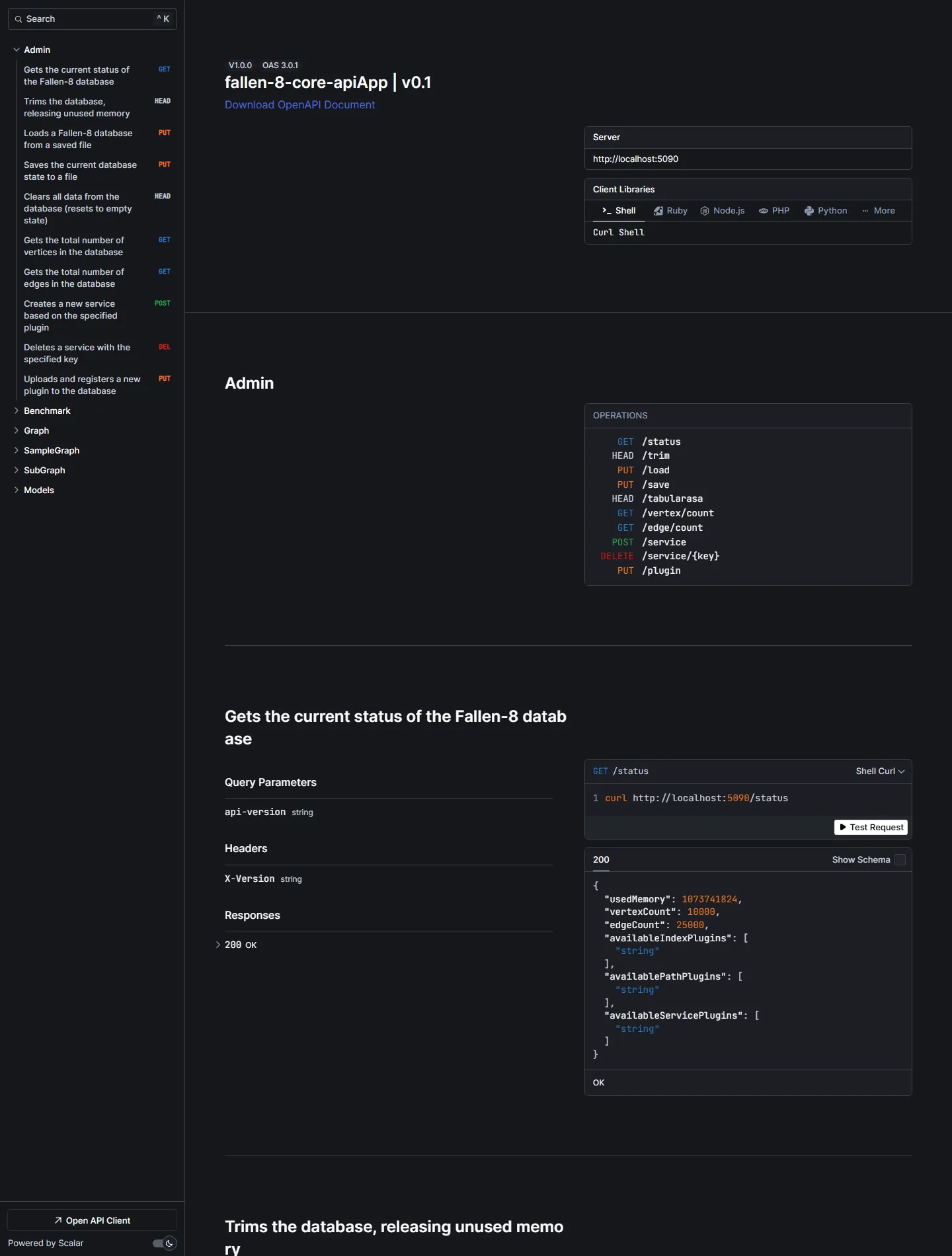
Versioning and route shape
Section titled “Versioning and route shape”The API is versioned at 0.1, the default. AssumeDefaultVersionWhenUnspecified is on, so you never have to name a version. To pin one, use any of the configured readers — the query string api-version, the X-Version header, or the media-type ver parameter. Responses carry api-supported-versions (ReportApiVersions).
Controllers declare [Route("api/v{version:apiVersion}/[controller]")], but every action overrides it with an absolute route (a template starting with /), so the version segment never reaches the URL. The routes are the bare paths — /path/{from}/to/{to}, /vertex, /status, … — exactly as the samples use them. /path/4/to/3 is a real route; /api/v0.1/path/4/to/3 is not.
# The bare path is the route; the version defaults to 0.1.curl -X POST http://localhost:8080/path/4/to/3 -H 'Content-Type: application/json' -d '{}'# Optionally pin the version (query string shown; the X-Version header works too):curl "http://localhost:8080/vertex/count?api-version=0.1"Invoke-RestMethod http://localhost:8080/path/4/to/3 -Method Post -ContentType application/json -Body '{}'Invoke-RestMethod 'http://localhost:8080/vertex/count?api-version=0.1'Conventions
Section titled “Conventions”These hold across the whole surface; each topic’s own page carries the detail.
| Convention | Rule |
|---|---|
| JSON casing | camelCase in both directions (Web defaults, source-generated). |
| Errors | Every error response is RFC 7807 application/problem+json — a consistent title/status/detail shape for a validation 400, a 404, a 409, and a server fault alike. The status codes are unchanged; only the body is uniform. |
| Not found / invalid | The engine follows Try*(out …) : bool; over REST an expected miss is a 404 (never an exception/500). |
| Mutations | Every write is a transaction; pass ?waitForCompletion=true to block until it commits. See graph model. |
| Status codes | Each action is annotated with [ProducesResponseType], so the exact codes and DTOs live in the OpenAPI document / Scalar, not here. |
| Namespaces | Every namespace-scoped route also answers under /ns/{name}/…; bare URLs address the reserved default namespace. See namespaces. |
| Authentication | When configured, the API key travels in the X-Api-Key header (name configurable) — the header name and key configuration are owned by security. |
Endpoint directory
Section titled “Endpoint directory”Every endpoint group and the page that documents it. Routes shown bare; each also exists under /ns/{name}/… unless noted (Fallen-8-level).
| Group | Routes | Doc |
|---|---|---|
| Vertices, edges & elements | PUT/GET /vertex, /vertex/{id}, /vertex/{id}/edges/…, PUT/GET /edge, /edge/{id}, GET/DELETE /graphelement/{id}, /graphelement/{id}/{propertyId}, GET /graph, GET /vertex/count, /edge/count |
graph-model.md |
| Indexes & scans | POST/PUT/DELETE /index…, POST /scan/graph/property/{id}, POST /scan/index/{all,range,fulltext,spatial} |
indexes.md |
| Vector search | PUT /index/vector/{id}, POST /scan/index/vector |
vector-search.md |
| Path finding | POST /path/{from}/to/{to} |
path-finding.md |
| Subgraphs | PUT/GET/DELETE /subgraph, /subgraph/{name}, /subgraph/{name}/graph, POST /subgraph/{name}/recalculate |
subgraphs.md |
| Stored queries | POST/GET/DELETE /storedquery, /storedquery/{name} |
stored-queries.md |
| Graph analytics | GET /analytics/algorithms, POST /analytics/{name}, /analytics/{name}/partition/{id} |
graph-analytics.md |
| Embeddings & semantics | PUT/GET/DELETE /graphelement/{id}/embedding/{name}, POST /embedding/{element,elements,search,text} |
semantic-traversal.md |
| Namespaces (Fallen-8-level) | GET /ns, GET/PUT/PATCH/DELETE /ns/{name} |
namespaces.md |
| Bulk import/export | GET /bulk/export, POST /bulk/import |
bulk-import-export.md |
| Change feed | GET /changefeed (Server-Sent Events) |
change-feed.md |
| Save games | PUT /save, PUT /save/all (Fallen-8-level), PUT /load, GET /savegames, /savegames/{id}, PUT /savegames/{id}/load, DELETE /savegames/{id} (Fallen-8-level) |
save-games.md |
| Delegate validation (Fallen-8-level) | POST /delegates/validate |
delegates.md |
| Plugin registration | POST /plugins/{algorithm,function}, POST /plugins/{category}/validate, POST /plugins/function/{name}/invoke, GET /plugins, GET/DELETE /plugins/{name} |
plugin-registration.md |
| Services | POST /service, DELETE /service/{key} |
plugins.md |
| Observability | GET /status, /statistics, /metrics, /healthz, /readyz |
observability.md |
| Sample & benchmark data | PUT /unittest, GET /generate, /benchmark |
samples.md |
| Maintenance | HEAD /trim, HEAD /tabularasa (clear graph), HEAD /tabularasa/all (Fallen-8-level) |
graph-model.md |
Generating a client
Section titled “Generating a client”The OpenAPI document is standard OpenAPI 3, so any generator produces a typed client from it — openapi-generator, NSwag, or Kiota all work. Point the tool at http://localhost:5000/openapi/v0.1.json (a Development dotnet run), or save that file and generate offline in CI.
See also
Section titled “See also”- Running Fallen-8 — launching the server for
dotnet run(Development) vs. Docker (Production) - Namespaces — the
/ns/{name}/…routing scheme and management API - Security — the API key header and key configuration (dynamic code is always on)
- Graph model — elements, properties, and the
waitForCompletiontransaction contract - Observability —
/status,/statistics,/metrics, and the health probes